Player debts in a ClubGG club: why clubs lose money on them
Sooner or later almost every private club on ClubGG starts giving chips on credit. A regular writes in the evening "give me 500, I'll send it tomorrow", the manager sends the chips, the game goes on. It works for both the player and the club: the tables stay full, and people the club trusts play more.
The trouble doesn't start when the chips go out. It starts a week later, when you need to know who actually owes what.
Where lost debts come from
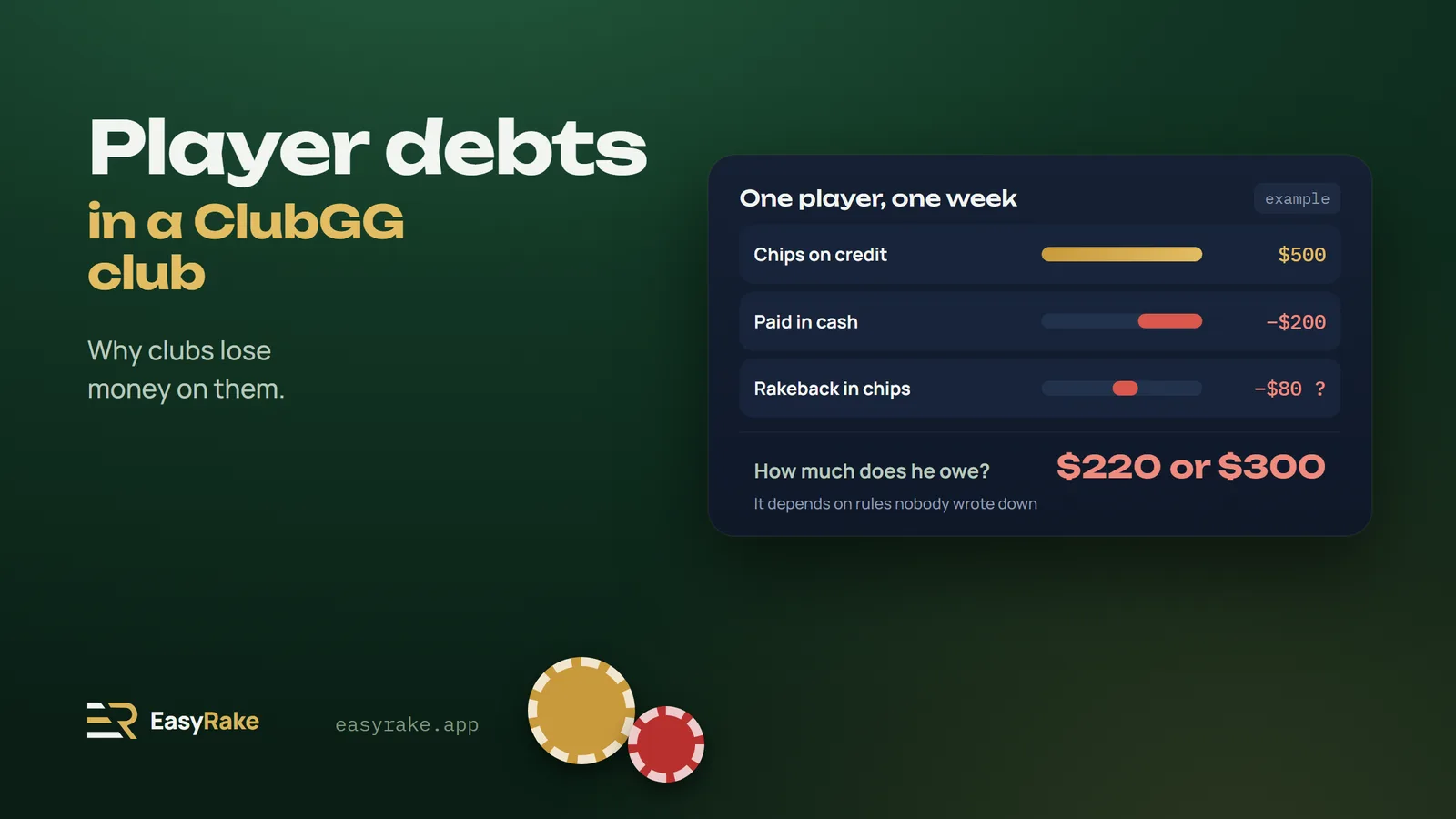
The debt lives in the chat. The manager sent chips in ClubGG and wrote it in notes, in a spreadsheet, or just remembered it. A couple of days later the player pays part of it, the next day he gets rakeback, then he wins and cashes out. Each event makes sense on its own, but together they turn into a number nobody can state with confidence.
Rakeback and debt get mixed up. A player earned rakeback and the manager paid it out in chips. Does that pay down the debt, or is it new chips on top? Without one rule in the club, a month later two people will have two different numbers for the same player. We covered how to calculate rakeback for each player separately.
There are several managers. One gave credit in the evening, another took a payment in the morning, a third moved chips between players. Each knows his part, and nobody sees the whole picture.
The player leaves the club. While someone is playing, the debt feels safe: he's here, he'll pay. When he disappears, it turns out there's no exact amount, and you can't argue with "about 800".
How to tell debts no longer add up
- the player names one amount, the manager another, and both are sure;
- the club's total debt changes even though nobody gave or paid anything;
- to answer how much a player owes, you spend half an hour scrolling the chat;
- the money in the wallet doesn't match what "should be there", and nobody knows why;
- the biggest debts always belong to long-time players the club "trusted".
If at least two of these sound familiar, the club is already losing money. Usually not on one big debt, but on dozens of small gaps nobody can prove.
What helps
A debt limit for each player. Not a general rule like "no more than a thousand", but each player's own limit that the manager sees at the moment of giving credit. Then the debt doesn't grow unnoticed, and going over the limit becomes a conscious decision.
One record per event. Credit, payment, rakeback, cash-out: each action is recorded right away and in one place, not in different chats by different managers.
Debt is calculated, not remembered. A player's number should come from the records, not from a manager's memory. Then an argument like "I paid, you didn't write it down" is settled in a minute.
Regular checks. Once a day or once a week, debts, chips and the money in the wallets should add up. If they don't, the mistake is easier to find right away, while everyone still remembers what happened.
What EasyRake does
EasyRake keeps the books of a ClubGG club in a Telegram app. The manager records credit, payments and cash-outs from the phone, and each player's current debt, chips and limit are always visible.
After every game day the owner gets a report: who owes what, who got how much rakeback, and whether the cash desk adds up. It already runs in live clubs.
Message us on Telegram